




Topics
Topics
- ICSIAPL project stories booklet 1
- Opportunity to grow the livestock sector through youth entrepreneurship 1
- Lessons learned from piloting mechanised forage production 1
- Addressing social norms and values to increase impact on women’s economic empowerment 1
- Advancing resilience in pastoral economies of Kenya 1
- Blended finance and technology transfer in the forage value chain 1
- Theme 1. Cimate Smart Agricultural Practices 5
- Theme 2. Pasture and Rangeland Management 8
- Theme 3. Fodder Management and Conservation 13
- Theme 4. Livestock Supplementary Feeds and Feeding 6
- Theme 5. Economics of Forage Production and Management 2
- Theme 6. Animal Health Management 11
- Theme 7. Animal Breeding, Fertility and Calf Management 10
- Final Report Forage Seed Sector FVC Study DeSIRA ICSIAPL 1
- Report on Forage Machinery and Implements 1
- Evaluation of alternative feedlot diets for Kasigau Ranch using Rumen8 1
- Getting the Incentives Right NEADAP/ICSIAPL Working Paper 1
- Forage Value Chain Presentation 1
- Forage Seed Market Study 1
- Forage Value Chain Report Taita Taveta County 1
- Forage Value Chain Report Narok County 1
- Forage Value Chain Report Kajiado County 1
- Horsetail Forage Factsheet 1
- Ex-Tozi Rhodes Forage Factsheet 1
- Dolichos Lablap Factsheet 1
- Desmodium Factsheet 1
- Cowpea M66 Factsheet 1
- Bush Rye Factsheet 1
- Velvet Beans as animal FeedsFactsheet 1
- Brachiaria Cobra Factsheet 1
- Sweet Potato as Forage Factsheet 1
- Brachiaria Camello Factsheet 1
- Sunn hemp Forage Factsheet 1
- African Foxtail Factsheet 1
- Sugar Graze Forage Factsheet 1
- Brachiaria Cayman Forage Factsheet 1
- Purple Vetch Forage Factsheet 1
- Panicum Maximum CV Mombasa Forage Factsheet 1
- Panicum Maximum Forage Factsheet 1
- Nutrifeed Forage Factsheet 1
- Lupin Forage Factsheet 1
- Lucerne Forage Factsheet 1
Topics
Topics
- Module 1: Calf Rearing 1
- Module 2: Nutrition and Feeding Dairy Cows in Kenya 1
- Module 3: Milk Quality and Hygienic Milk Production 1
- Module 4: Building for Cows in Kenya 1
- Module 5: Management of Napier Grass 1
- Module 6: Healthcare and Animal Disease Management 1
- Module 7: Managing Breeding and Fertily of Dairy Animals 1
- Module 8: Managing Breeding and Fertily of Dairy Animals 1
- Module 9: Planting Maize for Cattle 1
- Module 10: Making Maize Silage 1
- Module 11: Pasture Management 1
Topics
Topics
- Training Handbook for Production of Common Beans 1
- Training Handbook on production of Amaranthus 1
- Training Handbook on Production of African Nightshade 1
- Training Handbook on Indeginous Chicken Production 1
- Training Handbook for Production of Lab Lab 1
- Training Handbook for Production of Green grams 1
Topics
-
 BRIDGE+
 - Introduction
- Publications & Videos

Building Rural Income through inclusive Dairy Business Growth in Ethiopia (BRIDGE+)
BRIDGE+ Project Components

1. EXTENSION: Structured learning for farmers

2. INPUT MARKETS: Strengthening Agro-Input dealers

3. MARKET LINKAGES: Empowering Cooperatives
4. FOOD SAFETY: Support Quality StandardsEnforcement

5.NUTRITION: School Milk & BoP Dairy Products

6. PROFESSIONALISATION: Growing Commercial Dairy Farms

7. RESEARCH AND DEVELOPMENT: Innovation Through Research

8. POLICY

9. MONITORING, EVALUATION AND LEARNING
About Bridge+
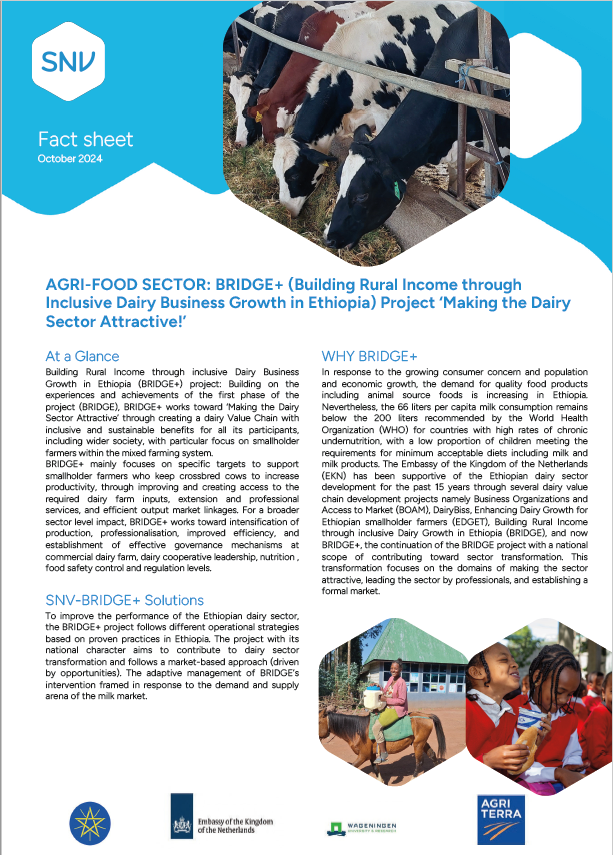
Building on the experiences and achievements of the first phase of the
project (BRIDGE), BRIDGE+ works toward ‘Making the Dairy
Sector Attractive’ through creating a dairy Value Chain with
inclusive and sustainable benefits for all its participants,
including wider society, with particular focus on smallholder
farmers within the mixed farming system. BRIDGE+ mainly focuses on specific targets to support smallholder farmers who keep crossbred cows to increase productivity, through improving and creating access to the
required dairy farm inputs, extension and professional services, and efficient output market linkages. For a broader sector level impact, BRIDGE+ works toward intensification of production, professionalisation, improved efficiency, and establishment of effective governance mechanisms at commercial dairy farm, dairy cooperative leadership, nutrition, food safety control and regulation levels.
In response to the growing consumer concern and population and economic growth, the demand for quality food products including animal source foods is increasing in Ethiopia. Nevertheless, the 66 liters per capita milk consumption remainsbelow the 200 liters recommended by the World Health Organization (WHO) for countries with high rates of chronic undernutrition, with a low proportion of children meeting the requirements for minimum acceptable diets including milk and milk products. The Embassy of the Kingdom of the Netherlands (EKN) has been supportive of the Ethiopian dairy sector development for the past 15 years through several dairy value chain development projects namely Business Organizations and Access to Market (BOAM), DairyBiss, Enhancing Dairy Growth for Ethiopian smallholder farmers (EDGET), Building Rural Income through inclusive Dairy Growth in Ethiopia (BRIDGE), and now BRIDGE+, the continuation of the BRIDGE project with a national scope of contributing toward sector transformation.


Donors
